





Last updated: November 15, 2026
Survey standards tell you how to look for contamination, how to sample it, and how to document what was found. Remediation verification tells you whether the cleanup really worked and whether the space can be used again. If the report has no standard behind it, no chain of custody, and no clear pass/fail rule, it is not verification — it is just a cleanup opinion.
Key takeaways
- A valid survey starts with the right standard, not with a sampler or a truck.
- Remediation verification is only as good as the rule it uses to decide “clean enough.”
- Visual checks, wipe samples, air samples, and clearance criteria do different jobs.
- The weakest point is usually documentation: missing locations, missing blanks, or vague units.
- Third-party verification matters most when the job is regulated, disputed, or likely to be sold or occupied.
An environmental consultant who reads sampling plans, lab reports, and clearance packages for a living needs to see the standard first, then the sampling design, then the proof that the cleanup endpoint was met.
What are survey standards and remediation verification?
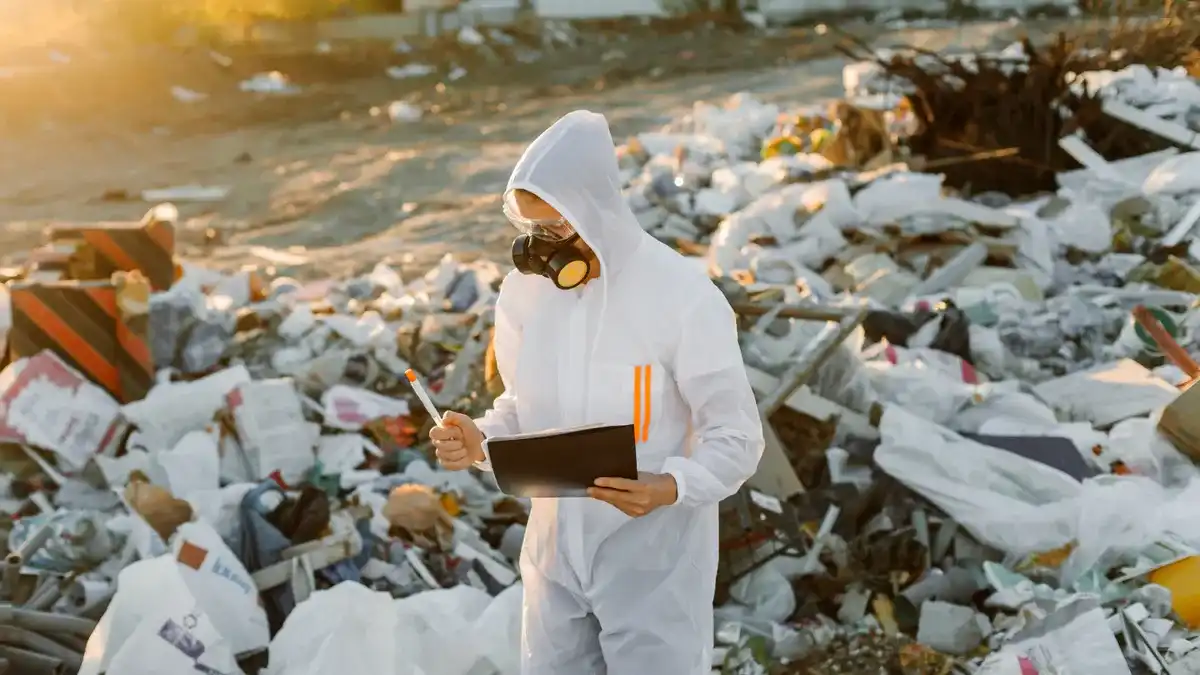
Survey standards are the rules that tell a technician how to inspect a site and collect data; remediation verification is the proof that the cleanup met those rules. In plain terms, the survey answers “what is there?” and verification answers “did the cleanup remove it to the required level?”
That difference matters because a cleanup can look finished and still fail. A room may be repainted, a floor may look spotless, and dust may still remain in cracks, ducts, or rough surfaces. A standard puts guardrails around the work by defining where to look, what to sample, how to report the result, and what counts as acceptable.
The term “verification” also covers more than one method. A visual inspection may be enough for some simple jobs, but many projects require a documented check using wipe samples, air samples, dust samples, or other field measurements. The right method depends on the hazard, the surface, the use of the space, and the rule being followed.
A generic cleanup note is weak evidence because it rarely says what was measured, where it was measured, or how the decision was made. A proper verification package usually ties the cleanup back to a named standard, a sampling map, lab results, and a written conclusion. If any of those pieces are missing, the result is harder to defend.
For background, the U.S. Environmental Protection Agency keeps public guidance on asbestos and related cleanup topics on its asbestos page, and OSHA maintains asbestos rules for worker protection:
https://www.epa.gov/asbestos
https://www.osha.gov/asbestos
Which standards actually control the work?
The controlling standard is the one tied to the hazard, the building use, and the agency or contract that governs the project. There is no single universal standard that fits every site, and that is where many reports go wrong.
Some surveys are driven by federal or state rules. Others are driven by a contract, an insurance claim, a lender, or a property sale. A school, hospital, warehouse, and apartment building may each need different documentation even if the visible damage looks similar. The method changes when the risk changes.
The most important standards are usually the ones that define three things: how the survey is done, how contamination is measured, and how the post-remediation condition is judged. In asbestos work, for example, the rule set often includes worker-protection rules, clearance requirements, and sampling procedures. In mold or water-damage work, the standard may lean more heavily on moisture mapping, visual inspection, and indoor air or dust checks, depending on the contract and the claim. In lead work, dust wipe criteria and clearance rules can control the end point.
A weak article on this topic often makes a common mistake: it treats “survey standard” as if it only means the lab method. It does not. The standard also includes the field plan, the sample spacing, the location naming, the blanks, the chain of custody, and the report format. One bad step can break the whole record, even if the lab number itself is fine.
The safest rule is simple: if the project has a regulator, a permit, a contract clause, or a health-based clearance rule, that rule comes first. If there is no named standard, the report should say so plainly and explain the basis for the endpoint. A report that skips that explanation leaves the owner exposed.
How does a proper survey get planned?
A proper survey starts with the question the report must answer, then works backward to the sample plan. That is the only way to avoid collecting the wrong data.
The plan usually begins with the site type, the suspected contaminant, and the decision the client needs. A pre-renovation survey has a different goal from a post-remediation verification survey. A tenant turnover in a small apartment is not the same as a clearance package for a commercial suite. If the question is not defined, the sampling grid is usually wrong too.
A good survey plan names the target material or hazard, the rooms or zones to inspect, the likely reservoirs, and the method for judging the result. It should also say what will not be covered. That last part matters because many disputes start when someone assumes a survey covered every hidden space, ceiling void, or duct run when it did not.
A common failure is over-sampling the easy places and missing the hard ones. Clean-looking open floor space may be sampled while baseboard joints, return-air grilles, carpet edges, and rough surfaces are ignored. Those edges often matter more than the middle of the room because residue collects there. A strong survey plan does not just count samples; it places them where residue is likely to hide.
The plan also needs a chain of custody and clear labels. Each sample should be traceable to a room, surface, date, and method. If one wipe sample is labeled “hallway” and another is labeled “north side,” the report may be impossible to defend later. Precision matters because a clearance package can be challenged months later in a sale, a claim, or a regulator review.
A decent plan is written before the first sample is taken. A weak plan appears after the fact, when someone tries to explain why the numbers look the way they do. That is too late.
What makes remediation verification credible?
Remediation verification is credible when the decision rule is visible, repeatable, and tied to a named method. A clean-looking room alone is not enough.
The first layer of credibility is the field observation. The verifier should document what was removed, what remains, and whether any dust, staining, debris, damage, or moisture is still present. Photos help, but photos alone do not prove a hazard is gone. They prove only what the camera saw in a few places at one time.
The second layer is measurement. Depending on the job, that may mean wipe sampling, air sampling, dust sampling, or moisture readings. The number has to be interpreted against the right threshold or clearance rule. A lab report without the rule beside it is only half a result.
The third layer is method integrity. The samples should be collected using the same standard, handled the same way, and sent to a lab that can report the method clearly. If blanks, duplicates, or field notes are missing, the report becomes harder to trust. The work may still be useful, but the confidence drops.
Credible verification also explains the boundary of the conclusion. A report should not imply that every hidden cavity, above-ceiling area, or sealed chase has been proven clean unless it was actually surveyed. That is a major blind spot in many project writeups. Verification is strongest where the method can reach; it is weakest where the structure hides the hazard.
The best reports also name the basis for pass/fail in plain language. For example, a clearance package might say the visible debris was removed, the samples met the clearance rule, and the cleaned areas matched the post-remediation scope. A vague sentence like “conditions were acceptable” is not enough if the space will be occupied, sold, or reopened.
What is the difference between a visual inspection, samples, and clearance?
A visual inspection shows visible condition, samples show measurable residue, and clearance is the formal pass/fail step that ties them together. Those are not interchangeable, and mixing them up is one of the most common errors in remediation work.
A visual inspection is fast and useful. It can show missing debris, standing water, failed surfaces, or obvious dust. It cannot, by itself, prove that fine residue is gone from porous material, joints, or air pathways. That is why a visual-only signoff is weak when the hazard is regulated or the site is controversial.
Sampling adds a number to the story. Wipe samples can show surface residue, air samples can show what is suspended in the air, and dust samples can check settled material. Each one answers a different question. A room may pass a visual check and still fail a wipe result, or the reverse.
Clearance is the formal endpoint. It combines the inspection, the sampling method, and the acceptance rule. A clearance decision should be written so another qualified person can retrace it later. If the report cannot be retraced, it is hard to defend.
| Criteria | Visual inspection only | Documented verification with samples | Winner for this condition |
|---|---|---|---|
| Main purpose | Checks visible condition | Checks visible condition plus measurable residue | Verification with samples for regulated or disputed work |
| Speed | Fast | Slower because of field work and lab time | Visual inspection only for a very simple, low-risk job |
| Defensibility | Weak on its own | Stronger because it has numbers and a method | Documented verification with samples |
| Cost burden | Lower | Higher because of sampling and lab fees | Visual inspection only when no formal signoff is needed |
| Hidden contamination | Easy to miss | More likely to be found if the plan is sound | Documented verification with samples |
| Best use | Quick progress checks | Final release, clearance, or claim support | Documented verification with samples |
| Failure mode | False confidence | Poor sampling design or bad documentation | Depends on the job scope |
| Evidence quality | Mostly subjective | More objective and repeatable | Documented verification with samples |
| Dispute value | Limited | Stronger in claims or sales discussions | Documented verification with samples |
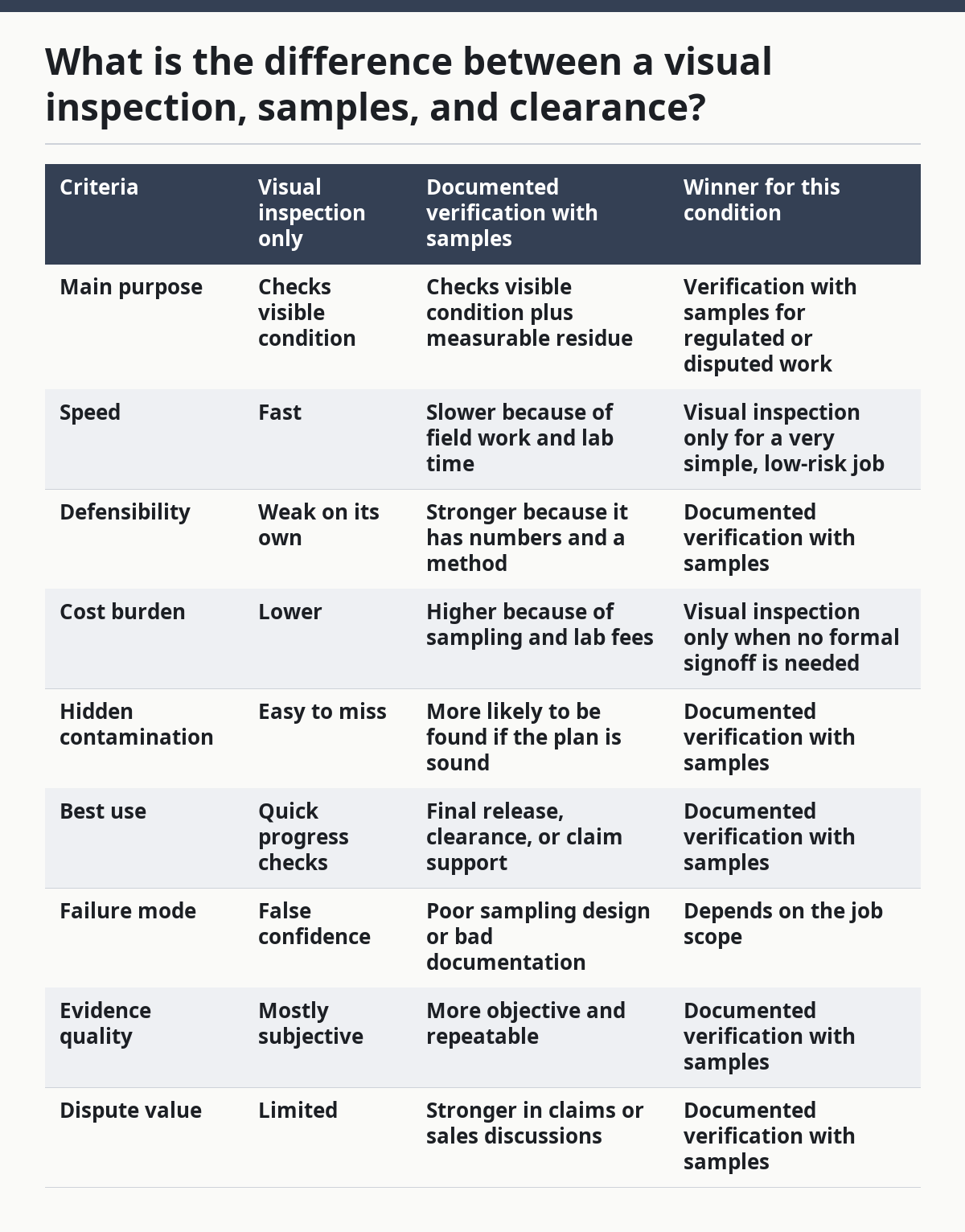
The table shows the real trade-off. A visual check is not wrong; it is just limited. It works best as a progress check or a quick screen. It is the wrong tool when the project needs a release document, a legal defense, or a formal clearance record.
Which approach should you choose?
Choose documented verification with a named standard if the cleanup involves a regulated hazard, a claim, a sale, a tenant turnover, or any situation where someone else will rely on the result. Choose a visual-only check only when the risk is low, the scope is simple, and no rule requires sampling.
That position is the safest one because the cost of a weak conclusion is not just a bad report. A weak conclusion can mean rework, delay, conflict, or refusal to reopen a room. In a small job, a visual check may be enough to confirm that work is complete. In a formal cleanup, it usually is not.
The best fit for documented verification is the job that needs proof. That includes spaces with a health-based endpoint, projects with a permit, projects under insurance review, and projects where the occupant will ask, “How do you know it is clean?” The answer has to be more than “it looked fine.”
The visual-only route works best when the cleanup target is obvious and the owner only needs a practical progress check. A small spill with no regulatory trigger may not justify a full lab-backed package. Even then, the report should say that no formal clearance was performed. Silence creates confusion later.
The most common mistake is trying to save time by skipping the standard and calling the result “good enough.” That shortcut looks efficient on day one and expensive on day thirty. If the project could be challenged later, the standard should be named now.
When should you stop and bring in a specialist?
A specialist should be brought in as soon as the scope crosses from cleanup work into proof work. If the result has to satisfy a regulator, insurer, buyer, landlord, or attorney, the survey should be handled like evidence, not like housekeeping.
That trigger shows up in a few clear cases. One is a multi-room or multi-floor site where contamination could travel through ducting, returns, or shared finishes. Another is a property with porous materials, hidden cavities, or damaged assemblies that make a quick visual check unreliable. A third is any job where the cleanup will be used to reopen a business, end a claim, or transfer a property.
A specialist matters because survey design is not just technical; it is procedural. The exact room names, sample points, lab method, and report language can decide whether the work holds up later. A report that is technically accurate but procedurally sloppy can still fail to persuade the people who matter.
Specialist help is also wise when the work touches more than one standard. For example, a project may need worker safety rules, a field sampling protocol, and a separate clearance rule. When those layers are mixed by accident, the report becomes hard to read and easy to attack. That is a bad place to save money.
This is also the point where “do it yourself” becomes risky. A property owner can inspect a room, but that is not the same as producing a defensible remediation verification package. If the project is simple and there is no formal endpoint, a basic check may be fine. If the project has a formal endpoint, the work belongs in professional hands.
What are the biggest mistakes in survey and verification work?
The biggest mistake is starting with cleanup and ending with documentation. The right order is the other way around: define the standard, define the endpoint, then clean to that endpoint.
A second mistake is using the wrong sample location. If samples are taken only where the surface looks best, the result can miss the place where residue actually stayed behind. The most useful locations are often the awkward ones: edges, corners, seams, and air pathways.
A third mistake is confusing a sample result with a whole-building conclusion. One room can pass and another room can fail. One surface can meet the criterion while a nearby surface does not. A report that blurs those differences creates a false sense of security.
A fourth mistake is weak paperwork. Missing room names, missing dates, missing method names, and missing blank results can damage a good field job. The person reading the report later may not care that the work was done well if the paperwork cannot prove it.
A fifth mistake is treating “clear” as a feeling instead of a decision. In verification work, the endpoint should be stated in writing. If the method uses a named clearance threshold, the report should show how the result compares with that threshold. If no threshold exists, the report should admit that and explain the logic used instead.
How should a good verification report read?
A good verification report should read like a decision record, not a sales sheet. It should say what standard was used, what was inspected, what was sampled, what the results were, and why the site passed or failed.
The report needs enough detail for another professional to follow the path. That means room names, sample locations, dates, methods, lab identifiers, and the clearance rule or decision basis. It should also include what was not included. A report that only tells the success story leaves out the edges where disputes often start.
A strong report uses plain language when it can. “Dust removed from baseboards and ledges” is clearer than “housekeeping completed.” “Two wipe samples exceeded the project criterion” is clearer than “some nonconformity was noted.” Simple words are not a weakness; they are a sign that the facts are solid enough to stand alone.
The report should also separate observations from conclusions. An observation is what was seen or measured. A conclusion is what the standard allows the reader to infer from that evidence. Mixing the two makes the document harder to audit.
A poor report often hides behind vague phrases such as “acceptable condition,” “appears satisfactory,” or “no significant issues observed.” Those phrases may sound professional, but they do not tell the reader what happened. A defensible report does.
FAQ
Do I always need samples for remediation verification?
No, not every project needs samples, but many projects do need them if the result has to be defended. A visual inspection may be enough for a simple, low-risk cleanup with no formal clearance rule. If the work is regulated, disputed, or tied to occupancy, samples are usually the safer choice.
What is the difference between a survey and clearance?
A survey is the broader search for what is present and where it is located, while clearance is the final pass/fail check after remediation. The survey maps the problem; clearance decides whether the cleanup met the endpoint. A job can have a survey without clearance, but a formal release usually depends on both.
Can I rely on a cleanup contractor’s own signoff?
You can rely on it only when the project does not need independent proof and the contract allows that kind of signoff. If the same party that cleaned the site also certifies the result, the record is weaker in a dispute. Independent verification is stronger when the work is regulated or likely to be reviewed later.
What should I ask for in the final report?
Ask for the standard used, the sample locations, the lab or field method, the acceptance rule, and a clear pass/fail statement. The report should also show room names, dates, and any limits on the conclusion. If those pieces are missing, the report is incomplete even if the cleanup looked fine.
When is a specialist worth the cost?
A specialist is worth it when the cleanup must hold up under review from a regulator, buyer, insurer, or attorney. The value is in defensible documentation, not just in taking samples. If the project is simple and no one needs formal proof, a lighter approach may be enough; if proof matters, specialist help is the safer choice.
Drafted with AI; not yet reviewed by a person.


One comment on “Survey Standards and Remediation Verification Guide”