



Last updated: November 17, 2026
A mortgage lender usually wants a completion certificate of remediation, plus clear supporting documents, before it will treat sprayed foam as a closed issue. The lender is looking for proof that the foam has been removed properly, that hidden timber or roof defects have been checked, and that the sign-off comes from a competent party such as a RICS chartered surveyor or a contractor with suitable indemnity insurance. This is information, not financial advice; a qualified adviser should be consulted for your own situation.
Key takeaways
- The certificate is not just a single sheet of paper; lenders often want a small evidence pack.
- The most useful sign-off links the removal work, the timber inspection, and the final condition of the roof space.
- A lender-approved foam removal certificate is stronger when it names the property, the scope of work, the dates, and who accepted responsibility.
- If the wording is vague, unsigned, or missing the inspection method, many lenders will ask for more.
- The safest route is to match the lender’s wording exactly rather than rely on a generic contractor letter.
Who needs this certificate?

This applies to a homeowner, buyer, or broker who has had spray foam removed and now needs a lender to accept the property again as mortgageable. It assumes the foam has already been taken out, or is due to be taken out, and that the next step is sign-off rather than the removal work itself.
The phrase people usually need to use is completion certificate of remediation. In plain English, that means a document saying the problem has been dealt with, the affected area has been checked, and the result is fit for the lender’s review. It is not the same as a sales brochure or a general contractor invoice.
This page does not cover lender lending policy comparisons, chemical stripper toxicity, or roof membrane replacement. Those are separate questions. It also does not tell you to borrow, refinance, or hold a property; it explains how the certification process works so you can judge what evidence is missing.
The standard path is strongest when the foam has been removed from the roof structure and a competent person has inspected the timbers afterward. The path is weaker when the work was done casually, the inspection was only visual from one point, or the paperwork cannot show what was checked and by whom. A certificate that omits those details often creates a second round of questions.
What do lenders want to see?
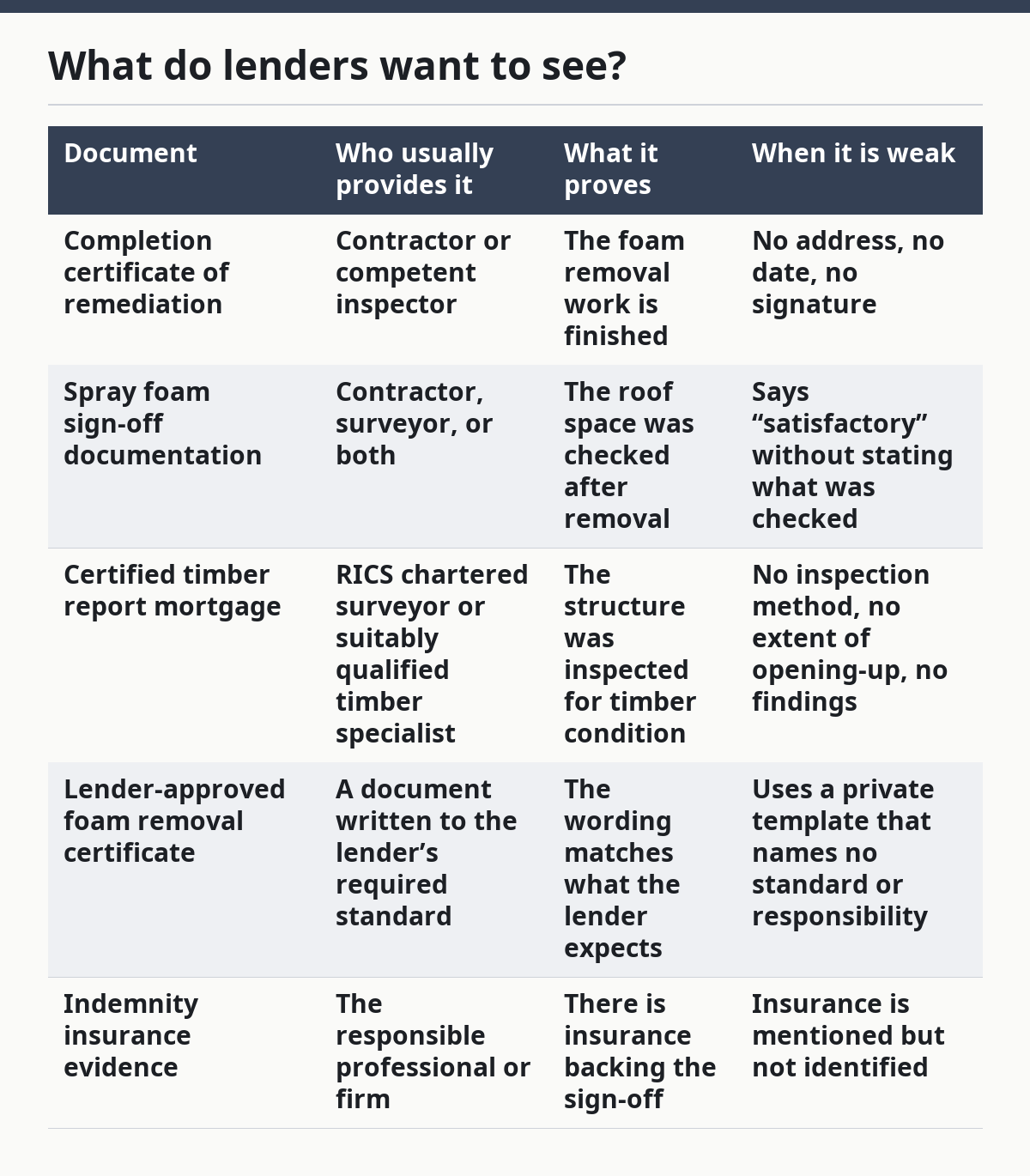
Lenders want evidence that the removal was completed, the structure was checked, and the remaining risk is described clearly. That usually means more than one document, because a lender is trying to understand both the work done and the condition left behind.
A generic “job done” note rarely carries enough weight. What usually matters is whether the document names the property, the removal method in general terms, the date of completion, the areas inspected, the condition of the timbers, and the person or firm taking responsibility. If there was any follow-up treatment, that should be stated too.
Here is the usual document mix in a lender-facing pack:
| Document | Who usually provides it | What it proves | When it is weak |
|---|---|---|---|
| Completion certificate of remediation | Contractor or competent inspector | The foam removal work is finished | No address, no date, no signature |
| Spray foam sign-off documentation | Contractor, surveyor, or both | The roof space was checked after removal | Says “satisfactory” without stating what was checked |
| Certified timber report mortgage | RICS chartered surveyor or suitably qualified timber specialist | The structure was inspected for timber condition | No inspection method, no extent of opening-up, no findings |
| Lender-approved foam removal certificate | A document written to the lender’s required standard | The wording matches what the lender expects | Uses a private template that names no standard or responsibility |
| Indemnity insurance evidence | The responsible professional or firm | There is insurance backing the sign-off | Insurance is mentioned but not identified |
A RICS chartered surveyor is a surveyor who belongs to the Royal Institution of Chartered Surveyors and works to that profession’s standards. A certified timber report is a report focused on the condition of roof timbers or other structural wood after the foam has gone. A Property Care Association member can be relevant where the lender wants a specialist in damp, timber, or remedial work, but membership alone is not the whole answer.
How do you build the sign-off pack?

You build it by matching the paperwork to the lender’s concern, not by stacking random documents. The lender wants a clear chain: removal, inspection, condition, and responsibility.
- Identify the lender’s exact wording. Ask for the lender’s written standard or case note, then check whether it asks for a completion certificate, a timber report, or both. Verify the names of required roles, such as a RICS chartered surveyor or a specialist contractor. A problem is any request that is only verbal, because verbal instructions are easy to misread later.
- Collect the property details before the report is written. Make sure the address, postcode, roof type, and room or loft location are correct on every page. Verify that the document uses one property identity only. A mismatch in address or flat number is a common reason for delay.
- Record what was removed. Note the type of spray foam, the affected area, and the broad method of removal in plain language. Verify that the note says the foam was removed from the relevant roof area, not just “treated.” A problem is vague wording that could describe cleaning rather than removal.
- Inspect the exposed structure. The surveyor or competent person should inspect the timber after removal and note whether the joists, rafters, or other visible members appear sound. Verify that the report says what was actually seen, not a generic “satisfactory” line. A problem is no mention of hidden or obstructed areas.
- State the limits of the inspection. If parts of the roof could not be opened up, the report should say so. Verify that any limitation is written clearly, with no claim that every hidden surface was seen if it was not. A problem is an overconfident certificate that makes a bigger promise than the inspection supports.
- Add the responsibility statement. The signatory should state who they are, what role they had, and what professional cover applies, including indemnity insurance where relevant. Verify that the letter names the firm and the signatory, not just a trading name. A problem is a document with no accountable person on it.
- Attach supporting evidence. Include photos, invoices, and any certified timber report mortgage lenders asked for. Verify that the dates line up: removal first, inspection after. A problem is paperwork dated before the work it is meant to confirm.
- Check the wording for lender use. The final page should say the property is ready for the lender’s review in respect of the foam issue, without promising loan approval. Verify that the wording avoids guarantees and sticks to the evidence. A problem is language that sounds like a promise of finance rather than a factual certificate.
That process is slower than sending a contractor invoice, but it is the usual way to reduce back-and-forth. The point is not to impress the lender; the point is to remove the doubt that made the lender pause in the first place. For context on mortgage standards and survey language, the Royal Institution of Chartered Surveyors and GOV.UK are useful reference points.
What should the wording say about indemnity insurance?
The wording should state who is responsible for the inspection, what professional cover exists, and that the certificate is based on the work actually checked. It should not sound like a blanket guarantee.
A useful clause usually does three things. First, it identifies the property and the date of inspection. Second, it says the signatory inspected the post-removal condition of the affected area and produced the report in that professional capacity. Third, it notes that the firm or professional carries indemnity insurance, where that applies, so the lender knows there is a defined professional backstop.
What should not be in the wording is just as important. Do not use language that claims the roof is “problem-free forever,” that all hidden defects are impossible, or that the lender must accept the property. Mortgage decisions are separate from the certificate. A report can support the case, but it cannot force a lending outcome.
A simple, lender-facing sentence often does better than a page of hype. Something like “Following removal of spray foam insulation, I inspected the accessible roof timbers and prepared this completion certificate of remediation for lender review” is clear because it names the work, the inspection, and the purpose. If the lender wants a certified timber report, the wording should say that report is attached or incorporated.
When should you stop and get a qualified review?
You should stop and get a qualified review when the paperwork no longer matches the condition on site. This is a money problem, not a paperwork game, and a weak certificate can cause delays, extra reports, or a fresh request from the lender.
The foam has been removed, but no one inspected the timbers: that means the lender may still see unresolved structural risk — get a timber report from a qualified surveyor before sending anything in.
The certificate names the wrong address or flat number: that means the document may not be accepted at all — correct the record and reissue the paperwork.
The signatory cannot show relevant competence or insurance: that means the lender may question the reliability of the sign-off — ask for a report from a RICS chartered surveyor or another properly qualified professional.
The report says “satisfactory” but gives no findings: that means there is no audit trail — replace it with a report that states what was seen, what was checked, and any limits.
The work involved partial access only: that means the inspection is incomplete — the report should say exactly what could not be seen and what that means for the lender.
The lender asks for a specific form and you only have a generic contractor note: that means the file is not in the right format — obtain the wording the lender asked for rather than guessing.
On a mortgage case, a vague letter is often worse than no letter, because it creates confidence in the wrong place. A precise report may take longer, but it gives the lender something real to assess.
What mistakes cause delays?
The most common mistake is treating the certificate as a formality. The lender is not checking a box; it is checking whether the evidence answers the risk created by the foam.
One frequent error is using a contractor invoice as if it were a completion certificate of remediation. The consequence is that the lender may ask for a separate sign-off. The correct alternative is a document that states the work is finished, identifies the property, and describes the inspection.
Another mistake is skipping the certified timber report mortgage lenders often want after removal. The consequence is that the lender still does not know whether the roof structure was checked. The correct alternative is a timber-focused report from a qualified professional.
A third mistake is overclaiming. If the certificate says the roof is fully problem-free, but the inspection was limited, the consequence can be rejection or a fresh request for clarification. The correct alternative is accurate wording with clear limits.
A fourth mistake is mixing dates. If the report date comes before the removal date, the lender may treat the pack as unreliable. The correct alternative is a clean timeline: removal, then inspection, then certificate.
A fifth mistake is leaving out professional status. If the sign-off does not show who wrote it and why they are competent, the lender may treat it as informal. The correct alternative is a named signer, role, and where relevant evidence of indemnity insurance or membership such as the Property Care Association.
When does the standard approach not apply?
The standard approach changes when the lender wants more than a basic post-removal note. That usually happens in cases where the roof has hidden damage, access was limited, or the existing documents do not line up.
If the roof space was not fully accessible, the usual certificate may need a narrower scope and a clearer limitation. The report should say that only accessible areas were inspected and that the lender may need more evidence. That is more honest than pretending the whole structure was seen.
If the lender has asked for a specific type of signatory, a general builder’s note is not enough. In that case, the safer route is a report from the type of professional the lender asked for, often a RICS chartered surveyor or another specialist whose role is clear on the page.
If the property has repeated reports, old removals, or older sign-offs that conflict with one another, the certificate pack needs a chronology. In plain terms, the lender wants to know what happened first, what changed, and what the current evidence supports. A simple one-page note rarely handles that well.
For a broader view of how this fits into lending decisions, the hub page on spray foam insulation mortgage lending criteria is the right place to go next. This page is only about the post-removal certificate standards that support that wider issue.
For formal definitions and survey standards, the Royal Institution of Chartered Surveyors and the Property Care Association are the organisations to look at first. Their terminology is often closer to what lenders expect than casual wording from a contractor template.
What counts as a good result?
A good result is a certificate pack that lets the lender read the file once and understand what was removed, what was checked, and who stands behind the report. It does not promise finance, but it removes avoidable doubt.
The best sign is not fancy wording. It is a clean timeline, a named property, a post-removal inspection, a timber report where needed, and a clear statement of responsibility. If the lender can see that chain on one or two pages plus supporting evidence, the file is much easier to assess.
A weak result is the opposite: vague language, missing dates, no named signatory, or a document that talks about “foam issues” without showing that the issue was actually remediated. That kind of paperwork can keep the case open even after the physical work is finished.
The practical standard is simple. If a lender could quote the certificate back to you and the sentence still makes sense, the wording is probably in the right shape. If it depends on assumptions, it is not ready yet.
Drafted with AI; not yet reviewed by a person.



One comment on “Post-Removal Mortgage Lender Certification Standards”