








Last updated: November 17, 2026
Quick answer: in 3 steps—disclose the foam, gather the paperwork, and expect lender checks—selling a house with spray foam insulation is possible, but it often means extra disclosure, slower buyer decisions, and a real chance of mortgage or valuation friction. In this sprayfoamsremovals.com selling a house with spray foam guide, the main issue is not the foam itself; it is how it affects inspection, roof access, and what must be stated on the TA6 property information form. This is information, not financial advice, and a qualified adviser should be consulted for your own situation.
Key takeaways
- Spray foam can complicate a sale because it may hide roof timbers and raise questions for valuers, lenders, and surveyors.
- The TA6 form matters because it is where known property issues and relevant history should be disclosed.
- Buyers with mortgages may need more evidence than cash buyers, who can sometimes move faster but may still ask for a lower price.
- The right approach often depends on the foam type, where it was installed, and whether the roof structure can still be inspected.
- A clean paper trail helps: installer details, product information, and any survey or sign-off documents can reduce uncertainty.
What does spray foam change in a house sale?

Therefore, spray foam changes a house sale because it can make the property harder to value and harder to inspect. In a residential property transaction, the concern is often that foam on the underside of a roof can conceal rafters, battens, leaks, or condensation damage that a surveyor would normally want to see.
That matters in plain money terms. If a buyer’s lender or valuer cannot get comfortable with the roof condition, the sale may slow down, be re-priced, or be limited to cash buyers. Estate agents may still market the home, but they will usually want the issue disclosed early rather than discovered after an offer is accepted.
The useful frame is this: the foam is not automatically a deal-breaker, but it is a due-diligence issue. The more the roof can be verified, the less room there is for uncertainty. The less it can be verified, the more risk gets pushed into the transaction.
For background on lender concerns, the hub article on spray foam insulation mortgage lending criteria sits alongside this guide. That wider context helps explain why the sale process can change even when the home itself looks sound.
Why do lenders and valuers care so much?
Because hidden roof structure creates uncertainty, lenders and valuers care, and uncertainty affects lending decisions. A valuer is not just checking market price; they are also looking for anything that could affect saleability or security for the loan. Foam that covers rafters can make that judgment harder.
The practical risk is not one single rule. It is a chain reaction. If the surveyor cannot confirm the roof condition, the lender may ask for more evidence, ask for a specialist report, reduce the loan amount, or decline to lend on normal terms. None of that means the property is unsellable, but it can narrow the pool of buyers.
This is where the words on the TA6 property information form matter. The form is part of the seller’s disclosure pack, and if the foam was installed, altered, or inspected, that history should be handled carefully and honestly. The Law Society’s guidance on property forms is worth reading alongside the form itself, because the point is to avoid avoidable disputes later: https://www.lawsociety.org.uk/topics/property/ta6-property-information-form
For survey context, RICS explains that surveyors assess visible condition and material risks as part of the home-survey process: https://www.rics.org/consumer-guides/home-surveys
A useful rule of thumb is simple: if a buyer, surveyor, or lender is likely to ask about the roof, answer the question before they have to chase it.
What should be disclosed on the TA6 form?

Specifically, the TA6 form should disclose what you know about the foam, when it was installed, and any issues that affect the roof or loft. If you know who installed it, what type of foam was used, or whether any survey was done before or after installation, that history belongs in the sale paperwork.
The form is not a place to guess. If you do not know the exact product type, do not invent it. If you do know the work was done to improve insulation but you also know it limited access to the roof space, say so plainly. That kind of disclosure helps the buyer understand the context instead of discovering a surprise in a survey report.
Keep any documents you have close by. Useful items include invoices, installer details, guarantees, product literature, and any roof inspection notes. Even a simple paper trail can help show that the issue has been handled openly rather than hidden.
If there has been water ingress, staining, or a roof defect in the past, that is different from a simple insulation upgrade. Do not blur the two. The buyer does not need a sales pitch; they need a clear record of what was done and what is known.
Which sale route fits the property best?
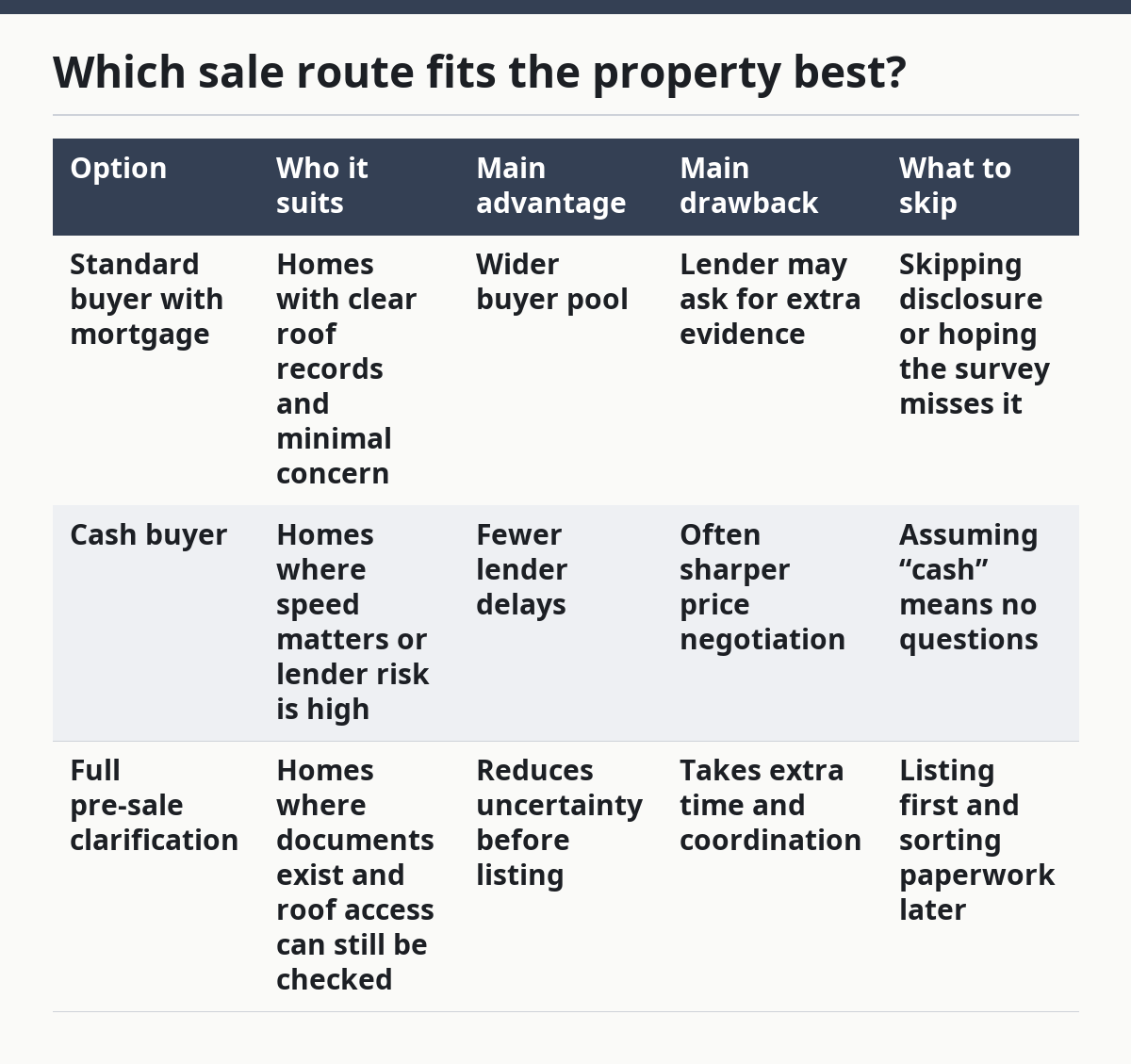
Ultimately, the right sale route depends on how much roof uncertainty the foam creates and how quickly you need the sale to complete. A mortgage-backed buyer may need more paperwork and more lender checks. A cash buyer can sometimes move faster, but cash buyers still price in risk and may negotiate hard if the roof cannot be inspected properly.
| Option | Who it suits | Main advantage | Main drawback | What to skip |
|---|---|---|---|---|
| Standard buyer with mortgage | Homes with clear roof records and minimal concern | Wider buyer pool | Lender may ask for extra evidence | Skipping disclosure or hoping the survey misses it |
| Cash buyer | Homes where speed matters or lender risk is high | Fewer lender delays | Often sharper price negotiation | Assuming “cash” means no questions |
| Full pre-sale clarification | Homes where documents exist and roof access can still be checked | Reduces uncertainty before listing | Takes extra time and coordination | Listing first and sorting paperwork later |
This is where estate agents can help with presentation, not repair. They can set expectations, flag the issue in the listing in a controlled way, and avoid wasting time on buyers who are unlikely to proceed. What they cannot do is remove lender caution if the roof is not verifiable.
The route to avoid is the one that depends on silence. If a buyer discovers the foam late, the sale can stall at the point where everyone has already spent time and money.
How do you prepare the sale properly?
Because the paperwork matters, you prepare the sale properly by building a clear evidence pack before the buyer’s survey starts. That means gathering the facts, checking the roof history, and making sure the disclosure and marketing line up with each other.
- Identify where the foam is. Check whether it is in the loft, on the underside of the roof, or on another part of the property. Verify the exact location in writing, and note any areas that remain accessible. A problem is any roof zone that cannot be seen without disturbing the foam.
- Find out when it was installed. Locate invoices, guarantees, or installer records with dates if they exist. Verify whether the work predates your ownership or was done while you owned the home. A missing timeline can be a problem, because buyers may assume the worst when dates are unclear.
- Collect product and installer details. Keep the foam type, installer name, and any system documents together. Verify whether the work was done by a named company and whether any sign-off exists. A problem is vague wording like “loft insulation” with no paper trail.
- Review the roof’s current condition. Look for leaks, staining, sagging, or ventilation issues, and record what is visible. Verify whether the roof can still be inspected in the usual way. Visible roof damage, sagging, or water staining may suggest the foam is not the only issue, so arrange a proper roof inspection before you keep marketing the home.
- Complete the TA6 carefully. Answer only what you know about the spray foam and the roof history. Verify that the disclosure matches the documents you have. A problem is any mismatch between the form and the evidence pack.
- Tell the estate agent early. Make sure the listing and conversations with buyers are consistent. Verify that the agent understands the likely lender concern so they do not oversell the property. A problem is letting a buyer assume a standard roof inspection will be straightforward when it may not be.
- Prepare for lender or surveyor questions. Have copies of the documents ready for the buyer’s solicitor or surveyor. Verify that every document is readable and dated. A problem is slow replies, because delays feed doubt and can weaken the buyer’s confidence.
A good result looks like this: the buyer knows about the foam early, the paperwork is ready, and the roof history is not a mystery. That does not guarantee a smooth sale, but it removes the kind of avoidable friction that causes deals to wobble.
What should make you stop and get help?
Then, if the roof issue is larger than a simple disclosure question, you should pause the sale process and get qualified help. This is where the transaction can move from “sell with caution” to “clarify first or risk trouble later.”
There is visible roof damage, sagging, or water staining: this may mean the foam is not the only issue, so arrange a proper roof inspection before you keep marketing the home.
You cannot tell what type of spray foam was installed: missing product details can raise more suspicion than the foam itself, so gather documents or ask a surveyor to assess the roof history.
The loft can no longer be inspected normally: that limits what a buyer’s surveyor can verify, so expect lender questions and be ready with evidence.
The TA6 form and the documents do not match: inconsistent records can create a disclosure dispute, so fix the paperwork before exchange discussions continue.
A buyer’s lender asks for more evidence than you have: the sale may stall until the issue is clarified, so do not guess and supply only what can be supported.
You are relying on a sale deadline to solve a wider roof problem: pressure can push the transaction into a weak position, so slow the process and address the roof question first.
The point here is not to panic. It is to avoid drifting into a sale that later collapses because the roof story was never made clear.
What mistakes do sellers make most often?
One common mistake, and one that the Law Society’s TA6 guidance helps avoid, is treating spray foam as a minor detail. In practice, it can shape the buyer pool, the survey, and the lender response. A small omission early can become a large delay later.
Another mistake is assuming a cash buyer means no scrutiny. Cash buyers still care about resale value, roof condition, and repair risk. They may simply express that concern in price rather than in lender conditions.
A third error is overclaiming in the listing. If the estate agent describes the home as “problem-free” while the paperwork suggests roof uncertainty, that mismatch can damage trust fast. The correct approach is to describe the facts, not to smooth them over.
A fourth mistake is leaving the TA6 form until the end. Once a buyer is already invested, any disclosure issue feels bigger. The better alternative is to complete the form with the documents in front of you and keep the answers consistent.
A fifth mistake is expecting one document to solve everything. A guarantee, invoice, or inspection note can help, but it does not remove the need for a careful lender and buyer review. Use the evidence pack to support the sale, not to promise an outcome.
When is spray foam a bigger problem than the sale itself?
Therefore, spray foam is a bigger problem than the sale itself when it has turned the roof into an unknown. If the roof cannot be inspected, the buyer cannot price the risk cleanly, and the lender may not be able to support the deal on normal terms.
That is the point where the transaction becomes about evidence, not just marketing. The sale can still happen, but the process often changes shape: more questions, more documents, and sometimes a narrower group of buyers. That is normal for a property with a known issue, but it is not something to gloss over.
The line between a manageable issue and a serious one depends on access, paperwork, and visible roof condition. A well-documented roof with clear history is one thing. A hidden roof with no records is another. The first can be sold with care; the second often becomes a negotiation over uncertainty.
For the reader who wants the shortest answer: tell the truth early, gather the papers, and expect lender scrutiny. That is the practical core of selling a house with spray foam insulation, and it is the part that keeps the process from turning into a dispute.
Drafted with AI; not yet reviewed by a person.




2 Comments on “Selling a House with Spray Foam Insulation”