







Last updated: November 16, 2026
Quick answer: in 3 checks — source, retention, and timber condition — spray foam roof timber decay and moisture analysis shows whether the roof needs monitoring or a structural repair. Spray foam roof timber decay and moisture analysis can show hidden roof timber decay, but it does not mean every rotten rafter was caused by foam alone. The real risk is moisture trapped against structural rafters or truss members, where timber moisture content stays high enough for decay fungi such as Coniophora puteana and Serpula lacrymans to grow. A proper moisture analysis looks for that hidden moisture path, not just the foam, and if the picture is unclear, consult a qualified surveyor. The spray foam roof timber decay and moisture analysis approach used by sprayfoamsremovals.com focuses on the moisture route, not assumptions.
Key takeaways
- Spray foam is a problem when it traps damp timber, not simply because it exists.
- Roof timber decay is often hidden until the foam is removed or the roof is opened up.
- Coniophora puteana and Serpula lacrymans point to damp conditions that need a source, not just a surface clean-up.
- Moisture readings matter more than guesses, because decay depends on timber moisture content staying high over time.
- The weak point is often the junction between bitumen felt, rafters, and insulation, where water can sit unseen.
What is the actual risk to roof timbers?
The actual risk is structural timber decay in rafters or trusses that stays wet behind the foam long enough for fungi to establish. Spray foam is not the root cause in every case; the root cause is usually water getting into the roof build-up and then being held there against the timber.
That matters because roof timber is not supposed to sit at a high moisture content for long periods. Once a rafter, truss chord, or purlin stays damp, the problem stops being cosmetic and becomes structural. The wood may still look sound from below while the inner fibres are softening behind the foam.
A generic article can get this wrong by treating all foam as damage and all damp as rot, so consult a professional if the roof history is unclear. In practice, the question is whether the roof has a moisture route that never dries out. Bitumen felt can trap water in one layer, while foam seals the underside and slows drying, so the timber sits between two barriers.
The first thing to look for is not “is there foam?” but “what is wet, for how long, and where can it dry?” A patch of staining near a valley, eaves, or chimney may be enough to matter if it has been active for months rather than days. Short-lived moisture is a nuisance; chronic moisture is the start of decay.
How does spray foam cause rafters to decay?
Spray foam causes rafters to decay by reducing drying and hiding the wet timber surface where decay fungi can work. If water enters through bitumen felt, a tile defect, flashing, or a failed overlap, the foam can keep the timber from airing out properly.
That mechanism is simple. Roof leaks do not need much water if the moisture stays trapped. A rafter that would normally dry after a small leak can remain at a damaging moisture content when the foam forms a tight layer against it. That is how hidden rafter damage develops in loft insulation zones.
The fungi named in decay workups matter here. Coniophora puteana is often linked with persistently damp timber. Serpula lacrymans is the classic dry rot fungus, but it still needs a moisture source to begin. Neither fungus appears because foam is present; they appear because the timber environment stays favourable for long enough. Guidance from the British Woodworking Federation and BRE supports that moisture-linked approach.
A useful way to think about it is in three conditions:
- Water gets into the roof build-up.
- The foam and surrounding layers slow drying.
- Timber moisture content stays high enough for decay fungi to grow.
That is why roof truss decay spray foam cases are so often a hidden-moisture problem first and a timber problem second. The foam can be part of the failure path, but the source is usually elsewhere in the roof covering.
How is moisture analysis done on a roof?
Moisture analysis on a roof is done by finding where water enters, where it sits, and whether structural rafters are drying or staying wet. It is not just a single pin test in one place.
A sensible analysis starts with roof geometry. Valleys, eaves, ridges, chimneys, and dormer cheeks are common moisture entry points because they gather water or flashing movement. After that, the condition of the bitumen felt, timber edges, and any visible staining is checked against the foam line. The goal is to match symptoms to a route, not just note that “everything looks damp.”
A practical inspection sequence looks like this:
-
Map the roof areas with the highest water load.
Focus on valleys, abutments, and eaves first, because these are the places where leaks often show up before the main roof field. This narrows the search to the 2 or 3 most likely entry points. -
Check the timber moisture content in more than one place.
One reading is rarely enough. Compare suspect rafters, truss members, and a visibly drier reference point so you can see whether the problem is local or spread across the roof. -
Look for a drying barrier.
Spray foam against timber, combined with bitumen felt above, can leave the wood with little chance to dry. If a roof bay has no clear ventilation path, wet timber can stay wet much longer. -
Look for fungal signs that match the moisture pattern.
White, brown, or cotton-like growth is not enough on its own. The important point is whether the growth is in a zone that has been wet for a sustained period and whether the timber has softened, cracked, or lost section. -
Decide whether the issue is active or historic.
Active moisture means the roof still has an entry route. Historic moisture may have left old staining and old decay but no current leak. That difference changes the next step completely.
This is where a lot of poor advice goes wrong. It treats “damp” as one category, so consult a professional if the pattern is not obvious. Roof timber decay and moisture analysis needs a chain of evidence: source, retention, duration, and timber condition. For reference, the NHBC and Historic England both stress diagnosis before repair on building fabric problems.
Which timbers need checking first?
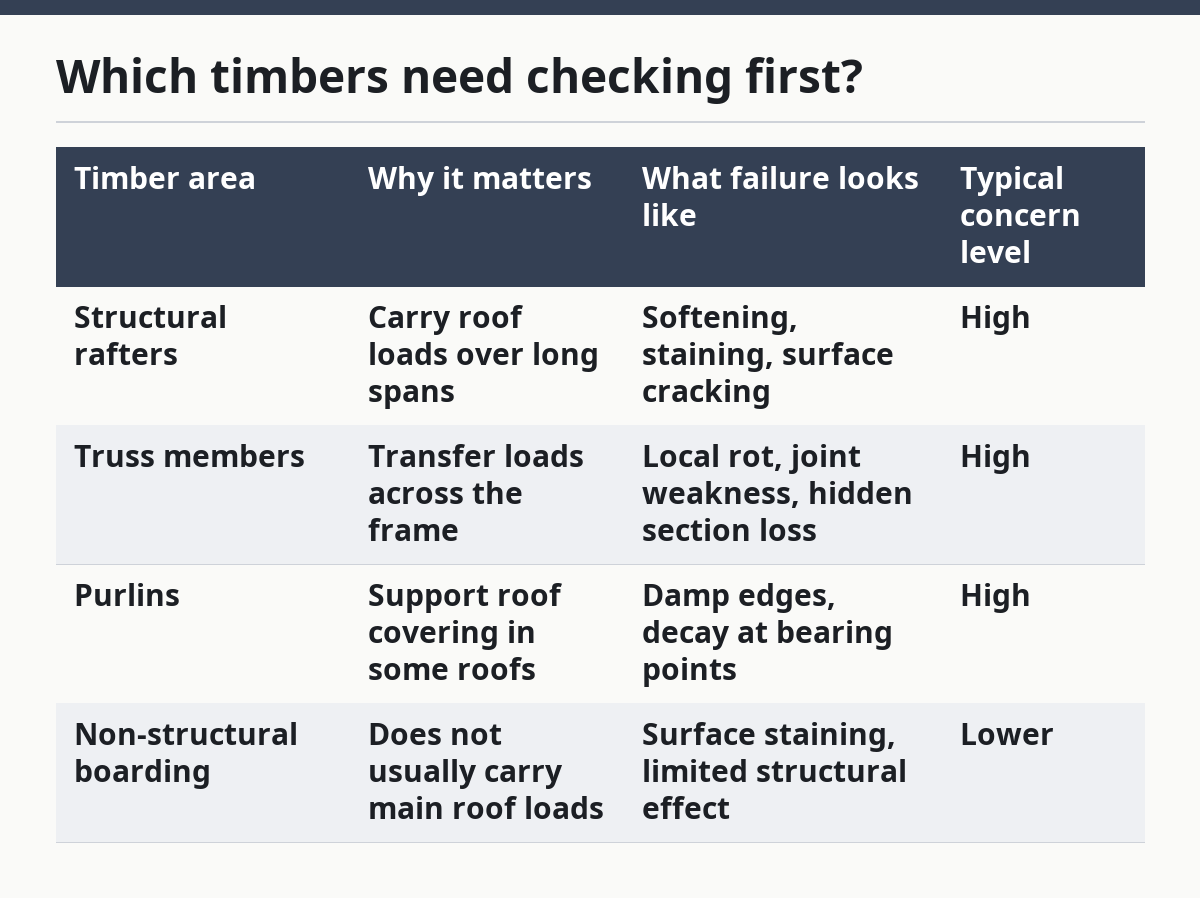
The first timbers to check are structural rafters, truss chords, purlins, and any timber close to a leak line. Those members carry load, so hidden decay matters more there than in a non-structural board.
Structural rafters deserve special attention because they often run the length of the wet zone. If a leak starts near the ridge or a valley, the same rafter can show wetting over a long run. Truss decay is easy to miss because the lower parts of the roof may look normal while the upper chord or web member has been damp for a long time.
A quick comparison helps sort the risk:
| Timber area | Why it matters | What failure looks like | Typical concern level |
|---|---|---|---|
| Structural rafters | Carry roof loads over long spans | Softening, staining, surface cracking | High |
| Truss members | Transfer loads across the frame | Local rot, joint weakness, hidden section loss | High |
| Purlins | Support roof covering in some roofs | Damp edges, decay at bearing points | High |
| Non-structural boarding | Does not usually carry main roof loads | Surface staining, limited structural effect | Lower |
Hidden rafter damage in loft insulation often shows up first as a change in colour or texture at the foam-timber interface. Once the timber face is enclosed, the outer appearance can be misleading. The real issue is whether the section has been reduced or the joinery has lost sound bearing.
A reader should not assume every dark mark is failure. Some marks are old. The deciding factor is whether the timber has been wet long enough for decay fungi to act and whether the member still has sound section at the stressed points.
What does Coniophora puteana or Serpula lacrymans tell you?
Coniophora puteana or Serpula lacrymans tells you that the roof has had enough moisture for decay fungi to colonise timber, but it does not tell you the leak source by itself. That distinction matters because the fungus is the symptom, not the cause.
Coniophora puteana is commonly associated with persistently damp timber and is often found where drying is poor. Serpula lacrymans gets more attention because of dry rot’s reputation, yet it still needs moisture from somewhere in the roof build-up. If either appears near foam-covered rafters, the next question is not “what fungus is it?” but “where did the water come from, and why did it stay?”
This is where a bad inspection can go wrong. A surface look may identify decay, but if the roof covering, felt, and flashing are not traced, the leak path remains open. The same issue can return after repairs if the source is left alone.
The presence of fungus also changes the urgency of the work. A small stain without fungal growth may be a monitoring issue. A fungus-confirmed decay zone on a structural rafter is a structural timber decay issue, because the timber may already have lost strength at the point that carries load. That is the line between cosmetic work and remedial work, and if there is doubt, consult a professional. Government guidance from the HSE and building-fabric advice from BRE both support diagnosis before intrusive work.
What mistakes lead to wrong conclusions?
The most common mistake is assuming the foam itself is the whole problem, which can lead to the wrong fix and wasted cost. Another mistake is treating one moisture reading as proof of failure, so a wider survey is often needed.
A roof can have foam and still be sound if the roof covering is intact and the timber remains dry. It can also have no visible roof leak in the room below and still have wet rafters above because the water is trapped in the roof build-up. That is why hidden rafter damage needs a roof-level inspection, not just a ceiling-level look.
A second mistake is cleaning or covering evidence before the source is understood. If staining, fungal growth, or softened timber is hidden again, the roof may look better while the moisture path remains active. The result is delayed failure, not a cure, so consult a professional before closing up the evidence.
A third mistake is confusing old and active decay. Old damage can remain after the leak is fixed, but old damage is not harmless if it sits on a load-bearing member. The timber may need verification of remaining section and bearing, not just a note that the leak is “gone.”
The best rule is to treat a structural rafter, truss, or purlin that has been damp long enough to support decay fungi as a reason for moisture analysis before any cosmetic conclusion is drawn. That is especially true where bitumen felt and spray foam have reduced drying on both sides.
When should you treat this as a structural problem?
You should treat it as a structural problem when decay reaches a load-bearing timber such as a rafter, truss chord, or purlin, or when moisture has clearly been trapped for long enough to soften those members. At that point the question is no longer just “is there damp?” but “is the roof frame still doing its job?”
One red flag is repeated moisture in the same 1 area after repair attempts. Another is visible fungal growth on a structural member, especially near a joint, bearing point, or roof support. A third is a roof that has no drying path because foam and felt are both holding moisture in the same zone.
This is not a situation for guesswork. A qualified inspection can separate active leak, historic damp, and actual timber decay. That matters because the repair path depends on whether the roof needs drying, local timber repair, wider remedial work, or only monitoring.
The honest drawback is that moisture analysis does not always give a neat answer in 10 minutes. Hidden roofs take time to read properly, especially when spray foam masks the timber surface. That delay is inconvenient, but it is better than missing a failing structural member. If the evidence is mixed, consult a professional and keep monitoring rather than guessing.
Does spray foam rot roof timbers?
Spray foam does not automatically rot roof timbers. The rot risk appears when foam helps trap water against timber and reduces drying, so the wood stays wet long enough for decay fungi to grow. If the roof stays dry and the timber moisture content remains low, foam is not the same as decay.
How does spray foam cause rafters to decay?
Spray foam causes rafters to decay by trapping moisture against the timber and hiding the wet surface from view. Water can enter through bitumen felt, flashing, or tiles, then stay in place because the foam slows drying. Over time, that creates the conditions for structural timber decay in rafters and truss members.
Drafted with AI; not yet reviewed by a person.