







Last updated: November 16, 2026
Key Takeaways
- Mechanical extraction means removing polyurethane foam with blades, scrapers, saws, and controlled hand force.
- The best tools are an oscillating multitool, a reciprocating saw with a controlled blade, and hand scrapers for the last layer.
- The process is done in short runs so the operator can stop before the blade reaches roofing felt or cuts into the rafter face.
- Alternating between reciprocating blades and manual scrapers can gouge timber rafters if the cutting edge bites after the foam has partly released.
Physical and mechanical spray foam extraction means cutting, scraping, and lifting polyurethane foam by hand and with tools, rather than dissolving it with chemicals. It is the right approach when the foam is bonded to timber rafters or sits close to roofing felt, because the aim is to strip the foam while limiting gouges, torn felt, and hidden wood damage.
What does mechanical extraction mean?
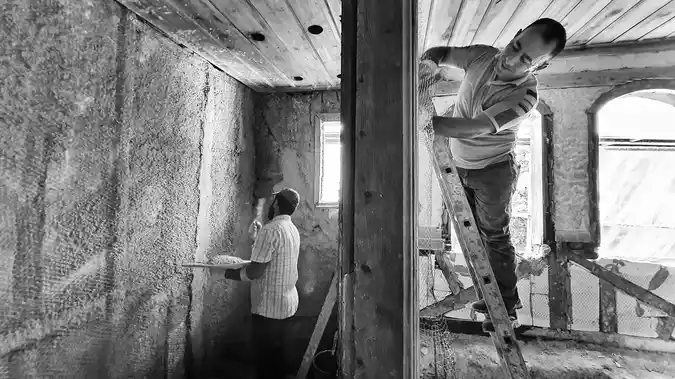
Mechanical extraction means removing polyurethane foam with blades, scrapers, saws, and controlled hand force. It usually starts with a visual read of the roof build-up: timber rafters, roofing felt, foam depth, and any brittle areas where the foam has locked into joints or nail heads. The method is physical, so the main skill is restraint, not power.
This matters because spray foam does not release cleanly like tape. It often bridges uneven timber, fills corners, and grabs at the underside of felt. A fast tool can clear a large section, but one wrong angle can leave a timber rafter nicked, a felt strip torn, or a shallow gouge that takes later repair work.
The phrase “sprayfoamsremovals.com physical and mechanical extraction methodology” points to a practical point: the process is about control at the timber line, not brute removal. In roof spaces, the safest approach is usually to work in small lengths, use the right blade for the right layer, and keep the tool moving before heat and friction build up. Even a single pass with a reciprocating blade can do more harm than several minutes of patient scraping.
A useful mental rule is simple. Foam goes first, timber comes second, and anything thin or fragile, such as roofing felt, gets treated like a barrier rather than a surface to attack. That order keeps the work focused on the polyurethane foam, not on the structure beneath it. For general tool safety, the HSE’s guidance on hand and power tools and OSHA’s hand and power tools guidance are both useful references.
Which tools do the work?
The best tools are an oscillating multitool, a reciprocating saw with a controlled blade, and hand scrapers for the last layer. An oscillating multitool is the most useful finishing tool because it removes foam in tight spaces with less side-to-side swing than a saw. A reciprocating blade moves faster, but it also increases the chance of catching timber rafters or punching into roofing felt if the operator rushes.
The hand scraper is slower, but it is often the safest tool for the final clean-up on wood. A wide scraper can peel brittle foam away from a rafter face without digging into the grain. A narrow scraper works better in corners, around old nails, and where the foam has cured into a thin ridge. The trade-off is speed: the more mechanical force used, the faster the clean-up, but the higher the risk of cosmetic or structural damage.
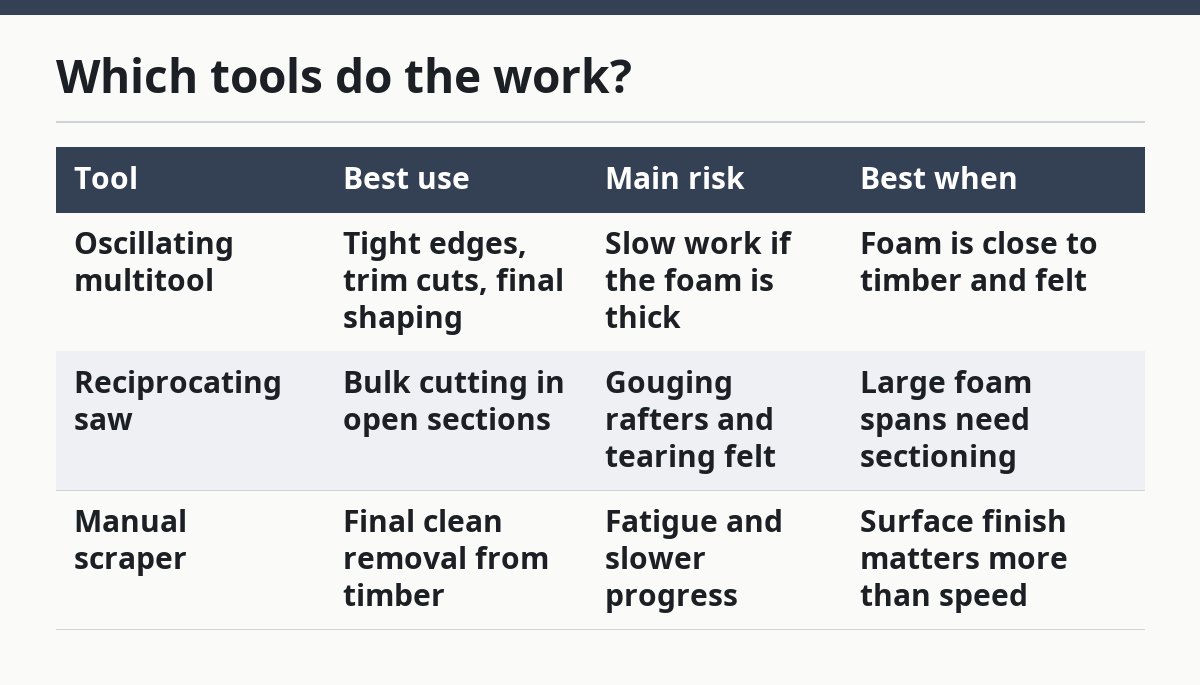
A practical comparison looks like this:
| Tool | Best use | Main risk | Best when |
|---|---|---|---|
| Oscillating multitool | Tight edges, trim cuts, final shaping | Slow work if the foam is thick | Foam is close to timber and felt |
| Reciprocating saw | Bulk cutting in open sections | Gouging rafters and tearing felt | Large foam spans need sectioning |
| Manual scraper | Final clean removal from timber | Fatigue and slower progress | Surface finish matters more than speed |
The right tool also depends on foam condition. Freshly brittle foam can fracture in chunks; dense, well-bonded foam may need score lines before it lifts. A blade that is too aggressive turns a removal job into a repair job. That is why the method usually alternates between cutting and scraping instead of relying on one tool from start to finish.
How is spray foam removed from a roof?
Spray foam is removed from a roof by scoring it, cutting it into controlled sections, lifting it away from the timber rafters, and then scraping the residue back to a clean wood surface. The process is done in short runs so the operator can stop before the blade reaches roofing felt or cuts into the rafter face.
A basic mechanical procedure looks like this:
-
Expose the work area and read the roof line. Clear loose debris, check the thickness of the foam, and identify where timber rafters and roofing felt sit. A short inspection saves rework because it shows where the foam is thin, where it bridges corners, and where a blade would be most likely to slip.
-
Score the foam into manageable strips. Use an oscillating multitool or a controlled saw blade to cut long foam runs into sections. The goal is not to reach the timber in one pass; the goal is to break the bond so the foam can be lifted without prying hard against the rafters.
-
Lift the cut sections by hand. Pull the foam away in strips or chunks once the cut line is complete. If the foam resists, stop and widen the score line rather than forcing it, because force is what turns a clean removal into a gouge.
-
Scrape the residue from the timber. Use a hand scraper to remove the thin layer left on the rafters. Keep the blade flat to the wood and work along the grain where possible, since cross-grain scraping leaves deeper marks.
-
Check for felt contact and wood damage. Look for torn felt, lifted fibers, or shallow cuts on the timber face. If a blade has marked the wood, stop using that edge immediately; a dull or hooked blade usually causes more damage than a sharp one.
-
Repeat in short lengths. Move along the roof in small sections rather than clearing a full run at once. That keeps control high and makes it easier to see whether the next strip is bonded to felt, timber, or a hidden joint.
This method is slower than aggressive demolition, but that is the point. A roof job is not won by speed alone. It is won by leaving the structure cleaner than it was before, with the least possible loss of timber section and the least stress on the roofing felt.
What can go wrong with alternating blades and scrapers?
Alternating between reciprocating blades and manual scrapers can gouge timber rafters if the cutting edge bites after the foam has partly released. This is the most common mechanical risk because the operator shifts from a power tool to a hand tool and then back again, often at a different angle each time. The problem is not the alternation itself; it is losing the cut line.
One risk is overcutting the rafter face. A reciprocating blade can skate once the foam breaks free, and the next push can bite into the wood. Another risk is tearing roofing felt when a scraper is driven under the foam edge too hard. Felt damage may not show immediately from the inside, but it can matter later if the roof build-up depends on that layer for separation or weathering.
A third risk is heat and dust buildup. Foam debris can clog a blade, blunt the edge, and force the operator to press harder. That extra pressure is where damage starts. A clean blade removes foam in a predictable way; a clogged blade turns the cut into a drag.
The fix is simple but strict. Use the saw to open the section, then stop and switch to scraping only where the foam has already loosened. If the foam still clings hard to the timber, make another shallow cut rather than prying. This is slower by minutes per section, but it protects the rafters, and in roof work the structure is worth more than the pace.
When is this method the right choice?
This method is the right choice when the foam is bonded to timber rafters and the goal is to preserve the roof structure. It is also the better choice when the foam is close to roofing felt, because controlled cutting gives more control than chemical softening or aggressive pulling. In a loft, the condition of the timber matters more than raw removal speed.
It is not the best choice when access is poor, the foam has spread deep into tight cavities, or the operator cannot keep a clean line. In those cases, the risk of nicking the timber rises fast. A section that seems simple at first can become slow if the foam bridges over old joints, wiring, nails, or uneven rafter faces.
Mechanical removal also suits a job where the end point is a visible timber surface. If the goal is a clean face for inspection, repair, or follow-on work, the method gives the operator more control over the last few millimetres than a broad stripping approach would. That last layer is where workmanship shows.
The main drawback is labor. This is not a quick tear-out process, and it is not forgiving of rushed hands. A manual scraper may take longer on the final pass, but it can save a rafter from a cut that would need repair. For that reason, the method is poor for anyone looking for speed above all else, and poor for anyone willing to trade structure for fast clearance.
How do you keep damage to a minimum?
Damage stays low when the blade is shallow, the foam is sectioned first, and the timber line is treated as the stop point. The rule is to remove the foam in layers rather than chasing the wood with one deep cut. That approach reduces the chance of a gouge and makes the last scrape cleaner.
A few habits matter every time. Keep one blade for open cuts and one scraper for finish work, because a dulled edge behaves unpredictably. Work in short sections, roughly one rafter bay at a time, so the cut line is always visible. Stop the moment the blade starts pulling wood fibers instead of foam, because that is the warning sign that the angle is wrong.
The method also depends on patience around corners. Foam often packs harder where timber meets felt, and those corners invite a pry-bar motion. That motion is what tears edges. A better move is to score both sides of the corner, lift the foam lightly, and finish the residue with the scraper flat to the rafter.
This is not the right job for anyone who wants a single aggressive pass to solve everything. The process rewards control, not force. The best result is a timber rafter that is left intact, a roofing felt layer that is not ripped open, and a foam removal line that can be inspected without guessing where the tool wandered.
What should a reader expect from the finished surface?
The finished surface should be clean timber with only light residue, not deep scoring or torn fibers. A perfect bare-wood finish is not always realistic after spray foam removal, because cured polyurethane can leave a stain, a thin film, or a roughened patch where it held tightly to the rafter. What matters is whether the wood remains structurally sound and readable.
A good finish lets the next inspection see the timber clearly. The rafter face should show the wood grain, the outline of any old fixings, and the boundary where foam once sat. If a section still carries thick foam ridges, the removal was incomplete. If the wood has long gouges or the felt is visibly cut, the removal was too aggressive.
The difference between acceptable and poor work often comes down to the last 10 mm of material. That is the layer where a scraper can clean the timber safely or scar it badly. A careful finish uses lighter pressure, shorter strokes, and frequent blade checks. It is slower, but it avoids the common failure of a roof job that looks quick and rough on first pass.
A reader looking for spray foam removal methods should take one thing from this: the finish matters as much as the stripping. In loft work, a controlled mechanical extraction is judged by what it leaves behind, not by how fast it got there.
What if the foam is stuck hard to the timber?
If the foam is stuck hard to the timber, it should be removed in thinner sections rather than forced off in one pull. A tight bond usually means the foam has cured into the grain or around old edges, and brute force is what causes gouges. The safer move is to rescore the foam, lift what will come free, and then scrape the remainder in short passes.
Can you remove spray foam without damaging timbers?
Yes, spray foam can be removed without damaging timbers, but only when the cut is shallow and the scraper stays flat to the wood. The risk rises when reciprocating blades are used too close to the rafter face or when a worker pries at stubborn sections. Careful sectioning, the right blade, and patience with the last layer are what protect the timber.
Drafted with AI; not yet reviewed by a person.



2 Comments on “Physical and Mechanical Spray Foam Removal”