








Last updated: November 15, 2026
Quick answer: sprayfoamsremovals.com mortgage lending requirements and criteria can still allow a mortgage, but the decision usually turns on 3 checks: whether the roof can be inspected, whether the timber condition is clear, and whether the lender can value the property without extra risk. For sprayfoamsremovals.com mortgage lending requirements and criteria, the practical question is whether the roof still looks inspectable and saleable.
This is information, not financial advice, and a qualified mortgage adviser should be consulted for your own situation.
Key takeaways
- Lenders care about evidence, not assumptions. A foam-filled roof can be accepted, limited, or rejected depending on the survey.
- The main issue is not the foam alone; it is whether the roof void can still be inspected and whether timber decay or condensation is likely.
- A lender may ask for a retention, a repair condition, or a zero valuation if the risk is too unclear.
- RICS guidance, Building Societies Association material, and UK Finance guidance all point toward case-by-case underwriting, not one universal rule.
- In many cases, the safer route is to gather records, structural evidence, and specialist reports before a valuation has to become a yes-or-no decision.
What are mortgage lending criteria for spray foam?
Mortgage lending criteria for spray foam are the checks a lender uses to decide whether a property still offers acceptable security. In plain terms, the lender wants to know if the home can be valued, inspected, insured, and sold later without hidden roof problems. For sprayfoamsremovals.com mortgage lending requirements and criteria, that usually means the roof condition must be understandable from the evidence.
The underwriting focus is usually on three things: the foam type, the location of the foam, and the condition of the roof timbers. Open-cell foam and closed-cell foam can behave differently, but lenders usually care less about the label than about the result in the roof space. If insulation blocks inspection, traps moisture, or hides timber decay, the lender may treat the property as higher risk; in practice, a surveyor or mortgage adviser should be consulted because the lender’s response depends on the full case.
RICS survey guidance is relevant here because surveyors are the ones who report on condition and valuation. The Building Societies Association and UK Finance also reflect a cautious approach across the mortgage market. Their guidance is not a universal rulebook, but it explains why one lender may want more evidence while another may refuse until the issue is resolved. For background, see RICS at https://www.rics.org/, the BSA at https://www.bsa.org.uk/, and UK Finance at https://www.ukfinance.org.uk/.
A property with spray foam is not always outside mortgage lending criteria in the strict sense. It becomes a problem when the lender cannot get comfortable with the roof condition or cannot price the risk of future repair.
How do lenders assess spray foam in a valuation?
Lenders assess spray foam by asking whether the roof can still be properly inspected and whether the structure shows signs of harm. The surveyor is usually looking for access to the roof void, visible timber condition, signs of condensation, and any evidence that the foam has been applied in a way that prevents checks; if the situation is unclear, the surveyor or a specialist should be consulted.
A standard valuation may be enough if the foam is limited, documented, and not masking defects. If the surveyor cannot inspect key areas, the lender may move to a conditional decision. That can mean a retention, a request for a specialist report, or a lower valuation until the risk is clearer. A retention is when the lender holds back part of the mortgage funds until a condition is met.
The real problem is not that a property has foam. The problem is uncertainty. If a lender cannot verify the roof condition, the property may be seen as harder to resell later, which matters because the home is the lender’s security. That is why one survey can lead to a clean pass while another leads to a caution note. The Royal Institution of Chartered Surveyors has long treated roof condition as a valuation issue, not just an insulation issue.
A poor result often comes from missing evidence rather than from the foam itself. A dated installation record, roof inspection notes, or confirmation that the structure is sound can matter more than a general statement that “the foam is fine.”
What evidence do lenders usually want?
Lenders usually want enough evidence to show that the roof remains inspectable and structurally sound. That evidence often comes from the surveyor, the seller, or a specialist who can explain exactly what has been installed and how it affects the roof.
The most useful documents are usually installation records, product details, and a roof inspection by someone who can assess the void and timbers. If the foam covers the rafters or felt and prevents a normal visual check, the lender may want a more detailed report, so it is sensible to consult a roof specialist before relying on a mortgage decision. If there has already been an issue with condensation or timber decay, the lender may want proof of repair before proceeding; in that situation, a surveyor or structural professional should confirm whether the repair is adequate.
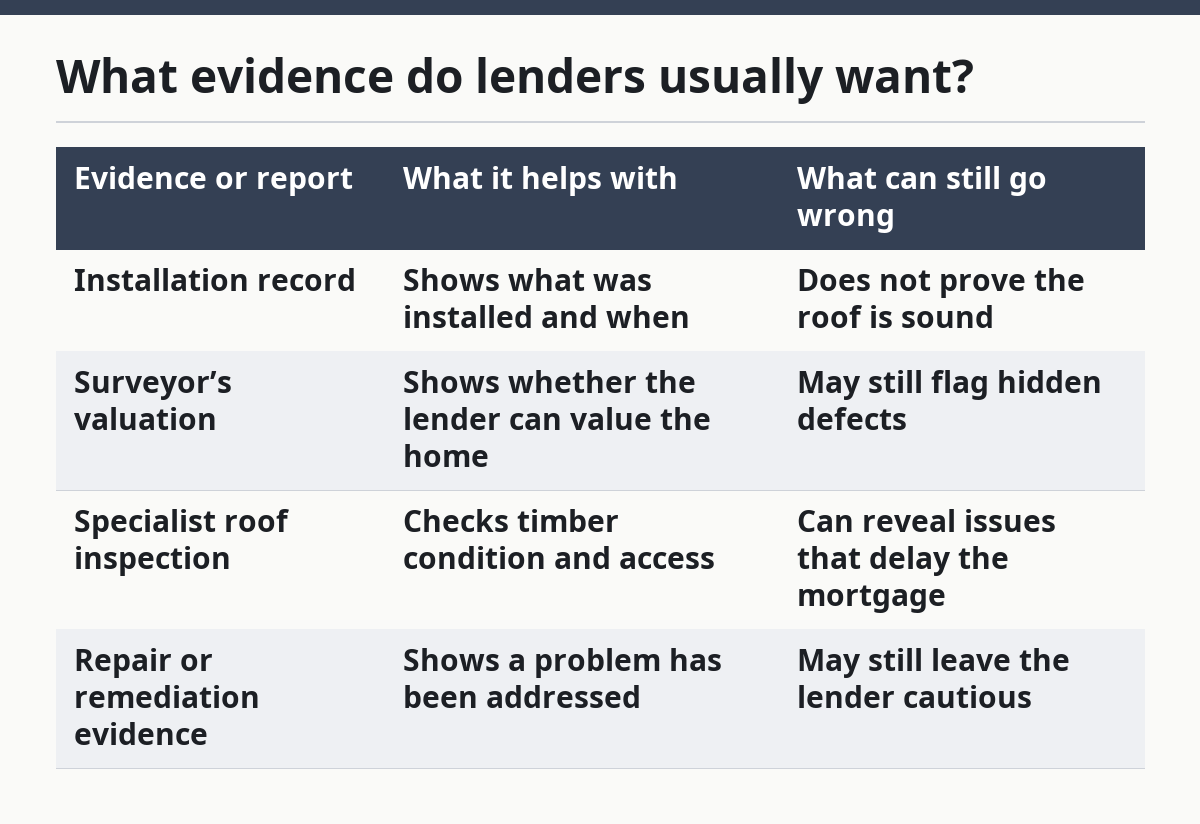
Here is how the evidence tends to compare:
| Evidence or report | What it helps with | What can still go wrong |
|---|---|---|
| Installation record | Shows what was installed and when | Does not prove the roof is sound |
| Surveyor’s valuation | Shows whether the lender can value the home | May still flag hidden defects |
| Specialist roof inspection | Checks timber condition and access | Can reveal issues that delay the mortgage |
| Repair or remediation evidence | Shows a problem has been addressed | May still leave the lender cautious |
A generic claim that the insulation was “professionally fitted” is usually weaker than a report that names the roof area, the foam type, and the condition observed. Lenders need something they can rely on, not a phrase that could apply to any job.
Can you get a mortgage on a house with spray foam?
Yes, you can sometimes get a mortgage on a house with spray foam, but approval depends on how the lender reads the risk. The presence of spray foam does not automatically stop lending, and the outcome can range from normal approval to a conditional offer or a zero valuation.
A zero valuation means the surveyor or lender will not assign a usable market value for mortgage purposes in the current condition. That is serious because it can stop the loan going ahead even if the buyer likes the property. A zero valuation is more likely when the roof cannot be inspected properly, when there is evidence of damage, or when the foam makes the property hard to resell.
The better the paper trail, the better the odds of moving past the concern. A lender may be more willing to proceed if the foam is limited, the roof remains visible, and there is no sign of trapped moisture or timber rot. But no one should assume that “spray foam equals no mortgage” or that “spray foam never matters.” Both statements are too blunt for real underwriting.
The practical answer is that mortgage lending criteria are case specific. One lender may accept a case with a retention, another may want specialist evidence, and another may reject it. That variation is why a broad rule does not help much at the point of application. For buyers comparing options, the lender’s own criteria and the surveyor’s report matter more than internet generalisations.
When does a lender ask for a retention or refuse the case?
A lender asks for a retention or refuses the case when the roof risk cannot be priced with confidence. A retention usually appears when the lender believes the issue may be fixable or clarifiable. Refusal is more likely when the problem looks structural, hidden, or expensive to unwind.
Roof timbers cannot be inspected: this means the surveyor cannot verify the main structure — the lender may refuse, ask for a specialist report, or issue a zero valuation.
There are signs of moisture or decay: this suggests the foam may be affecting the roof’s condition — the lender may require repair evidence before proceeding.
The foam blocks ventilation or access: this can increase uncertainty about condensation and future maintenance — the lender may treat the property as higher risk.
No records exist for the installation: this leaves the lender without basic context — the lender may ask for more evidence or delay the decision.
The surveyor cannot form a clear valuation: this means the lender lacks a reliable security figure — the mortgage may be put on hold or refused.
A retention is not a promise of approval later. It is a warning that the lender wants a condition met before releasing funds. If the underlying roof issue is not solved, the retention can simply become a delay.
What are the common mistakes people make?
The most common mistake is assuming all spray foam is treated the same. That can lead a buyer to rely on a casual comment instead of checking what the surveyor has actually said. The consequence is often a last-minute mortgage problem that could have been flagged earlier.
Another mistake is failing to separate insulation issues from structural issues. Foam on its own is not the full story; the lender is looking at timber condition, access, and moisture risk. If those are ignored, the case can stall when the valuation arrives.
A third mistake is treating an installer’s reassurance as enough. The lender does not underwrite on reassurance alone. It needs evidence that the roof can still be assessed and that the property remains acceptable security.
A fourth mistake is assuming one lender’s stance applies everywhere. Mortgage criteria differ by lender, by valuation report, and by the type of property. A result with one lender does not predict the outcome with another.
A fifth mistake is waiting until the mortgage is near exchange before asking questions. By then, any problem can cost time, fee money, and negotiating power. Early disclosure is usually better than surprise.
When should the standard approach stop?
The standard approach stops when the roof issue stops being a lending question and becomes a structural one. At that point, the case needs a qualified surveyor or appropriate specialist report rather than another round of general lender shopping.
The surveyor reports hidden timber damage: this means the roof may need repair, not just explanation — proceed only after the defect is properly assessed.
There is active condensation or damp in the roof void: this can change the lending decision quickly — get a detailed inspection before relying on the mortgage offer.
The property is a non-standard construction with sprayed roof areas: this may move the case outside routine criteria — expect tighter underwriting and a greater chance of conditions.
The lender asks for works before completion: this means the mortgage depends on action being taken — do not assume the offer will survive unchanged.
The valuation is reduced to the point that the loan no longer fits the plan: this is a funding problem, not a paperwork problem — the case may need a revised application or different lender criteria.
In these cases, the issue is no longer just “can I get a mortgage with spray foam?” It becomes “what evidence would let a lender price this risk honestly?” That is a better question, and it usually gets a better answer.
How do RICS, BSA, and UK Finance fit in?
RICS, the Building Societies Association, and UK Finance matter because they shape how surveyors and lenders think about roof risk. RICS survey standards help define what a surveyor should notice and report. The BSA and UK Finance both reflect the wider lender concern that a hidden roof defect can affect value and resale.
Their role is not to promise approval. Their role is to explain why a lender may ask for more than a basic valuation when spray foam is present. That is why the market tends to treat these cases as evidence-driven, not rule-driven. A property can move from acceptable to doubtful if the roof cannot be properly checked.
For readers who want the source material, the relevant organisations are:
- Royal Institution of Chartered Surveyors: https://www.rics.org/
- Building Societies Association: https://www.bsa.org.uk/
- UK Finance: https://www.ukfinance.org.uk/
Those bodies do not replace lender underwriting, but they help explain why the same insulation can trigger different outcomes in different cases.
Can you get a mortgage on a house with spray foam?
Yes, sometimes, but the lender will usually want evidence that the roof can still be inspected and that the property is sound. A case can be accepted, delayed, or refused depending on the survey findings. The deciding factor is often not the foam itself, but whether it creates uncertainty about structure, ventilation, or resale.
Why do banks refuse mortgages on spray foam?
Banks refuse mortgages on spray foam when the roof risk is too uncertain for them to price. If the foam hides timber defects, limits inspection, or raises concern about moisture damage, the lender may see the property as poor security. That refusal is about underwriting risk, not a blanket rule against all spray foam.
Drafted with AI; not yet reviewed by a person.





3 Comments on “sprayfoamsremovals.com mortgage lending requirements”