



Last updated: November 18, 2026
Quick answer: a sprayfoamsremovals.com independent timber surveyor sign-off inspection is usually a short, evidence-based third-party check, and a cautious reader should treat it as a specialist review rather than a guarantee. It is the third-party check that confirms the exposed timber is dry enough, clean enough, and visible enough for re-insulation or onward works after spray foam removal. It is not the removal contractor’s own warranty note. The point is an unconflicted timber surveyor sign-off inspection that looks at roof rafters, moisture equilibrium, and wood hygiene before anyone covers the structure again. If there is any doubt about damp, decay, or access, consult a professional timber specialist and refer to guidance from the Property Care Association, RICS, and BS 5250.
Key takeaways
- A sign-off inspection is about evidence, not reassurance.
- The main job is to confirm complete wood surface exposure and basic timber hygiene after removal.
- A contractor’s own certificate is not the same thing as an independent timber surveyor report.
- The result should help a lender, insurer, builder, or homeowner decide what can happen next.
- If the timber is still hidden, damp, or contaminated, sign-off should wait.
What is a timber surveyor sign-off inspection?
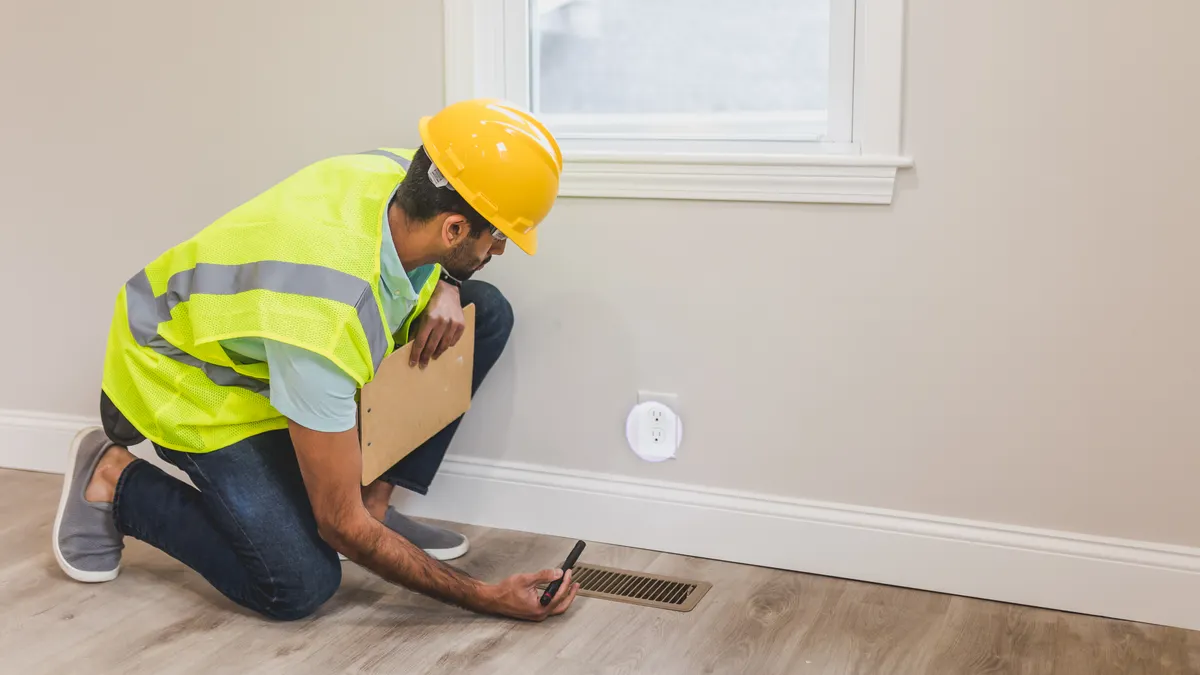
A timber surveyor sign-off inspection is a third-party report that says the roof timbers or other structural timber can be accepted after spray foam removal. It is usually carried out by a certificated surveyor in remediating timber in buildings, often someone with CSRT-level knowledge and a working grasp of timber decay, moisture, and ventilation.
The key phrase is “independent.” A removal contractor may issue its own completion note or warranty certificate, but that is not the same thing as an independent damp and timber survey sign-off. One document shows the contractor believes the job is done; the other shows a timber specialist has checked the exposed wood, the surrounding conditions, and the likely risk of concealed damage.
This matters because spray foam can hide defects. It can trap dirt, mask staining, and make it hard to see whether roof rafters were already affected by decay, past leaks, or poor ventilation. A proper surveyor sign-off should therefore be treated, with professional advice where needed, as a wood hygiene audit as much as a visual inspection. The surveyor is not just ticking off surface foam removal. The surveyor is deciding whether the timber is fit to be judged on its own merits again.
The distinction is simple, and it saves arguments later. A removal company’s paper may say the foam is gone. A specialist timber surveyor roof sign-off says the timber is now sufficiently exposed and assessed to stand on its own. If those two things do not line up, the second opinion is the one that matters more.
For the wider context, this page supports the hub on survey standards and remediation verification. That hub is the right place for the bigger framework; this page stays on the practical sign-off step.
Who conducts spray foam timber sign-off inspections?
A competent sign-off is normally done by an independent timber surveyor, not by the spray foam removal crew. In practice, that usually means a certificated surveyor in remediating timber in buildings, often working in line with Property Care Association practice and the standards expected of timber specialists.
The person signing the report should be able to read what they are seeing in a roof void or loft space. They need to understand roof rafters, junctions, staining, old repairs, and signs that moisture has not yet returned to equilibrium. That matters because timber that still holds excess moisture can look stable for a short period and then fail later. A rushed sign-off can, in some cases, miss that risk, so consult a professional if the picture is unclear and refer to RICS and BS 5250 guidance.
There is also a conflict issue. If the same business removes the foam and signs the timber off, the report is much less useful as an independent check. A buyer, broker, insurer, or lender is looking for a clear separation between the removal job and the assessment of the timber. That separation is the whole point of independent work.
A generic surveyor who only knows broad building survey terms may not be enough. This task is more specific than a standard snagging visit. It asks for a specialist timber surveyor roof sign-off, not a casual glance at a cleared loft. If the timber has delicate staining, old fungal markers, or mixed-age repairs, the wrong person can miss the real issue.
What does the report check?

The report checks whether the exposed timber is visible, clean, and fit for acceptance after spray foam removal. It should not be a single-line note. A useful timber hygiene certificate post-spray foam removal usually records what was seen, what was not accessible, and whether the timber condition needs follow-up.
A good report normally covers the visible roof structure, especially roof rafters, purlins, collars, and other accessible members. It should say whether the foam has been removed enough for the wood surface to be inspected properly. It should also note any residue, staining, softening, distortion, or dampness. If the roof space still smells musty or shows signs of ongoing moisture, that matters as much as the visible surface.
The surveyor is also checking the setting around the timber. If the loft still lacks proper ventilation, if there are signs of condensation, or if moisture equilibrium has not been reached, the timber may not yet be ready for acceptance. In that case, a sign-off should hold back rather than paper over the problem.
Here is the usual split between the documents people often confuse, although exact wording can vary by firm:
| Document | Who issues it | What it is for | What it is not |
|---|---|---|---|
| Removal contractor completion note | The foam removal business | Confirms the foam-removal job was carried out | Independent proof that timber is fit to accept |
| Internal warranty certificate | The contractor or its insurer | Gives the contractor’s own warranty position | Third-party timber condition assessment |
| Independent timber surveyor sign-off | A separate specialist surveyor | Confirms the exposed timber has been assessed after removal | A promise that future issues can never occur |
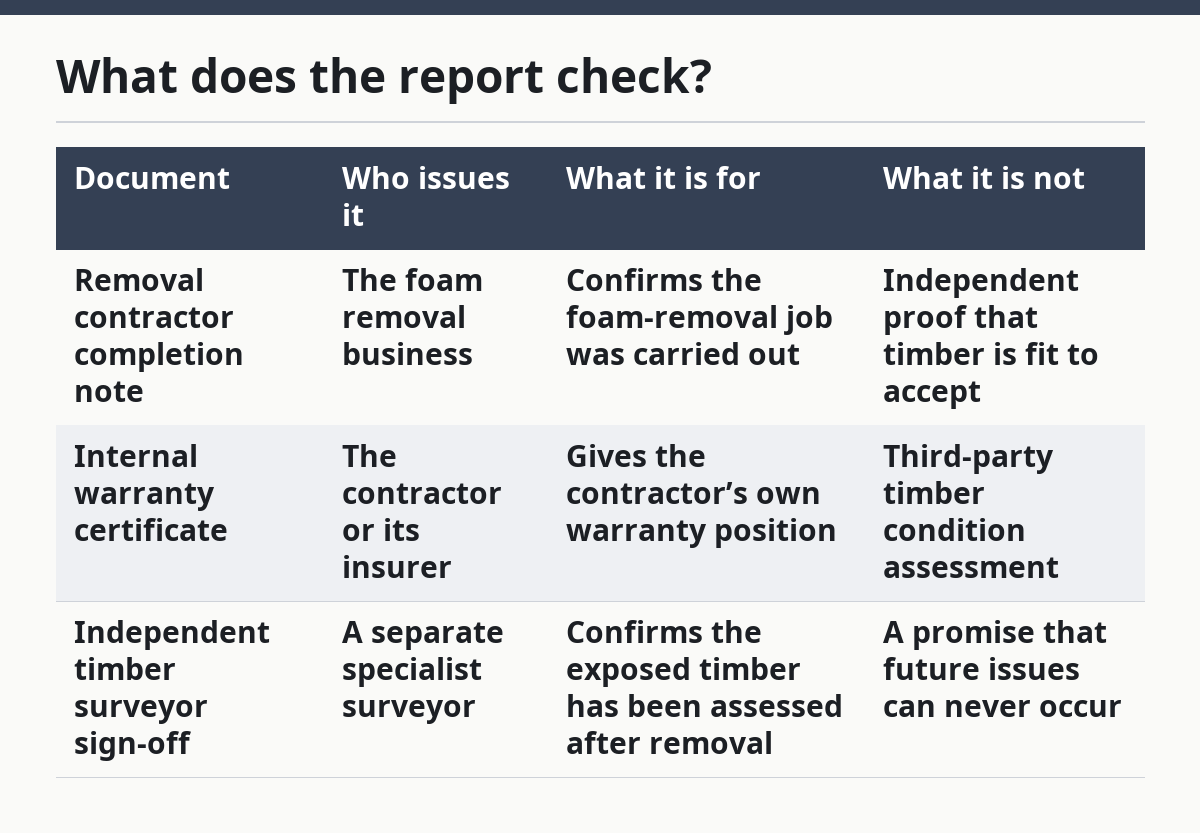
The best reports use plain language. They should say what was checked, what access was gained, and what is still uncertain. If the timber is sound but still damp, that is not a clean sign-off. If the timber is dry but has not been fully exposed in some places, that is also not a clean sign-off.
How does the inspection happen?
The inspection happens as a structured check of the exposed timber after the foam has been taken off. It is not a drive-by visit and it is not just a quick photo set. The process should leave a clear trail from access, to observation, to written conclusion.
-
Confirm full foam removal from the relevant timbers.
The surveyor should first check whether the roof rafters and adjacent members are actually visible, not just partly cleaned. If foam still masks the wood in key areas, the inspection stops short of true sign-off. -
Inspect the timber surface under stable lighting.
A loft or roof space needs enough light to show staining, splits, soft patches, and old repairs. The point is to see the wood itself, not guess at it through dust or shadow. -
Check for signs of damp or decay.
The surveyor looks for active dampness, old leak marks, fungal change, and distortion. If moisture has not returned toward equilibrium, the report should record that the timber is not yet at a comfortable condition for acceptance. -
Record what can and cannot be seen.
Access limitations matter. If a section remains hidden behind finishes, services, or residual material, that must be written down. A report that skips hidden areas is weaker than one that says exactly where access was limited. -
Decide whether sign-off is justified.
The final step is not just “looks okay.” It is a reasoned conclusion on whether the exposed timber can be accepted, whether more drying or cleaning is needed, or whether further investigation is needed before re-insulation.
This sequence is useful because it matches the real job. The surveyor is not certifying perfection. The surveyor is deciding whether the structure has been exposed enough for a sensible, independent judgement.
What is the difference between contractor and independent sign-off?
The difference is independence and purpose. A contractor document says the removal work was done; an independent timber surveyor sign-off says the timber condition has been separately judged. That distinction is the heart of the issue for sprayfoamsremovals.com independent timber surveyor sign-off inspection.
A contractor’s paper may be fine for internal tracking. It may even mention a warranty period. It is still not the same as a specialist timber surveyor roof sign-off because the contractor has a direct interest in the outcome. That matters when the next party in the chain wants a neutral opinion.
The table below shows the practical difference:
| Question | Contractor certificate | Independent timber surveyor sign-off |
|---|---|---|
| Who stands behind it? | The removal business | A separate timber specialist |
| Main purpose | Confirms the job was completed | Confirms the exposed timber was assessed |
| Best use | Internal record, warranty file | Acceptance of timber condition |
| Main weakness | Conflict of interest | Can still be limited by access or hidden areas |
The independent version is usually the one people want when the timber has to be handed over for the next stage. That stage may be re-insulation, a building report, or another check by a third party. The inspection is less useful if it simply repeats what the removal contractor already said.
This is also where honest limits matter. A timber surveyor can sign off the exposed surfaces they have seen. They cannot promise that no hidden issue will ever emerge later. If a roof has a concealed defect behind finishes or in an inaccessible pocket, no responsible report should pretend otherwise.
When should you not accept a sign-off yet?
You should not accept a sign-off yet if the timber is still partly hidden, still damp, or still carrying signs of unresolved damage. A rushed report can, in some cases, make a problem look finished when it is only partly treated, so consult a professional if the evidence is incomplete.
The first red flag is incomplete exposure. If the foam remains in corners, behind fittings, or across sections of roof rafters, the surveyor does not have a full base for judgement. The second red flag is moisture that has not settled toward a sensible level. Timber that has not reached moisture equilibrium can still change shape, hold decay risk, or create a poor base for future works.
The third red flag is a report that says very little. If the document does not name the timber areas checked, the access limits, and the condition found, it is too thin to rely on. A one-paragraph letter is not the same thing as a proper wood hygiene audit.
This is the point where a cautious reader saves time later. If the sign-off is being used to support next-step works, the report should be specific enough that another competent person can understand what was checked in about 20 minutes of reading. If it cannot do that, it is not ready.
That caution is especially important for anyone dealing with a roof space that has a history of foam concealment, past leaks, or mixed repairs. Those cases deserve a specialist timber surveyor, not a generic clearance note.
What should you ask for in the report?
You should ask for a report that states exactly what was inspected, what was exposed, and what conclusion was reached. A proper timber hygiene certificate post-spray foam removal should not rely on vague phrases like “appears satisfactory” without any detail.
At minimum, the report should identify the property area, the timber elements seen, and whether the inspection was independent. It should note the condition of roof rafters and other visible members, the presence or absence of moisture-related signs, and any limitations on access. If the surveyor uses a specific professional title such as certificated surveyor in remediating timber in buildings, that helps the reader understand the level of specialism.
You should also expect the report to say whether the timber is fit for the next stage, or whether more drying or further work is needed first. That part matters because a report can be honest without being alarming. It may say the timber is exposed and usable, while still noting that some areas need attention before re-insulation or closure.
Do not ask the report to do a lender’s job or a mortgage retention job. That belongs to a different page and a different process. On this page, the question is simpler: is the timber now clear enough and stable enough for independent acceptance after foam removal? If the answer is yes, the report should say so plainly. If the answer is no, it should say that too.
For readers who want the wider standards picture, the best next stop is the hub on survey standards and remediation verification. This page sits under that framework and focuses only on the sign-off step itself.
Who conducts spray foam timber sign-off inspections?
An independent timber surveyor usually conducts them, often with specialist remedial timber knowledge rather than general inspection habits. The right person should understand roof rafters, moisture behaviour, and the signs of concealed damage after foam removal. A contractor can finish the removal, but a separate specialist should provide the sign-off.
What is included in a post-removal timber clearance report?
A post-removal timber clearance report should say what timber was exposed, what condition was seen, and whether the wood is acceptable for the next stage. It usually records roof members checked, moisture-related signs, access limits, and any remaining concerns. A brief note is weaker than a report that names the areas inspected and the reason for the conclusion.
Drafted with AI; not yet reviewed by a person.